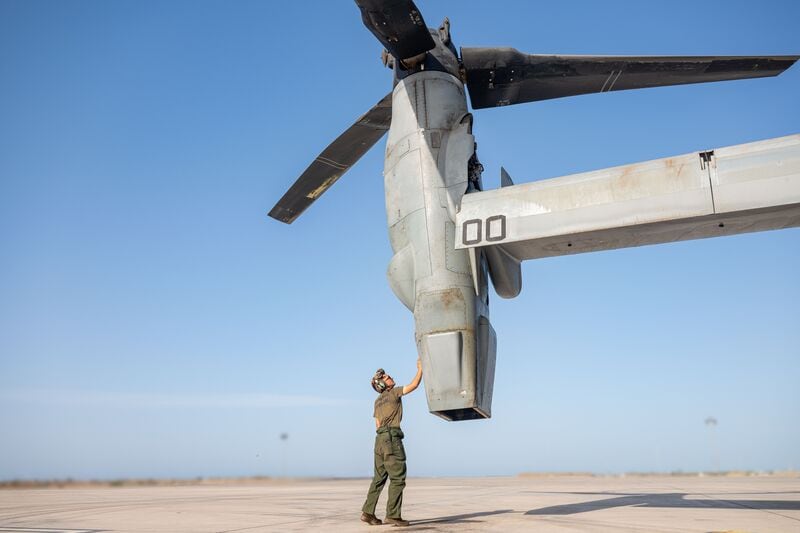
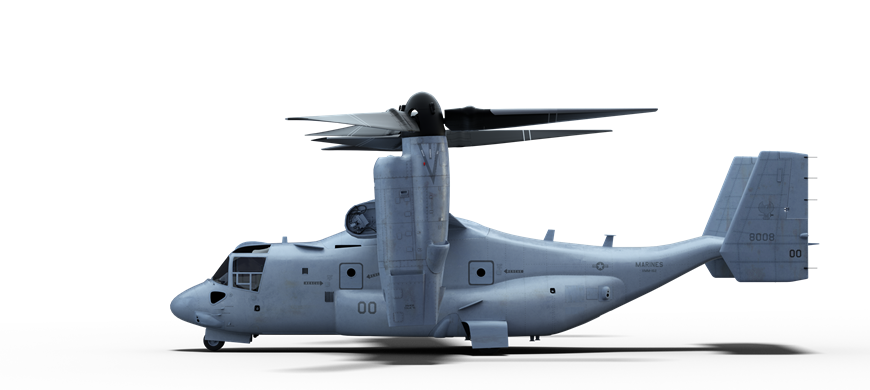
The Bell Boeing V-22 Osprey is one of the most distinctive aircraft ever built. It takes off like a helicopter, rotates its engines forward, and flies like a turboprop plane. That ability to do both things well has made it invaluable to the U.S. Marine Corp, Air Force Special Operations Command and the Navy. It also puts stress on one critical component: the nacelle.
If you’re not familiar with the term, the nacelle is the housing that surrounds each of the V-22’s two engines and tiltrotor assemblies. On a conventional airplane, nacelles are relatively straightforward: they hold the engines in place and smooth out the airflow. On the V-22, they do all of that and can rotate 97 degrees from vertical to horizontal during flight. That’s a lot to ask of any structure, and after decades of analysis, Bell and its partners have developed a comprehensive improvement program to make the nacelle better and easier to maintain.
The V-22 Nacelle Improvement program delivers a proven, combat-ready enhancement that strengthens mission readiness today – not tomorrow. Developed and refined through rigorous testing and operational validation, this program addresses critical nacelle reliability challenges with a solution that is already performing in the field. Warfighters and maintainers don’t have to wait for the next generation of capability; the improvement is here; it’s proven and it’s ready to be fielded across the fleet. It all drives higher availability rates and keeps aircraft where they belong – in the air and in the fight.
The NI program started with the the AFSOC’s CV-22 fleet, and the results have been nothing short of transformational:
Here’s the operational difference: When a component is flagged during pre-flight checks, maintainers can return an upgraded Osprey to mission-ready status quicker. On a non-modified aircraft, that same issue could ground the platform for a longer period of time.
That could be the difference between mission success and missed opportunity.

The Nacelle Improvement program isn’t one single fix; it’s a package of upgrades designed to address concerns that have shown up through years of real-world operations.
Maintainer informed feedback has helped shape this program.
Maintainability is another key driver. Military aircraft are only useful when they’re flying, and the Nacelle Improvement program will reduce the time and labor required to keep each aircraft in service. Some components inside the nacelle are notoriously difficult to access, requiring significant teardown before a technician can even reach what needs to be inspected or replaced. Redesigned access panels, simplified routing for wiring and plumbing, and parts that can be swapped out more quickly all add up to less time on the ground.
The program also addresses conversion system reliability — the mechanical linkage and actuators that actually tilt the nacelle between helicopter and airplane mode. This system is unique to the V-22 and critical to its mission. Improvements here are focused on reducing the time between critical part changes.
The V-22 has been in service since 2007, with the design going back even further. That means the fleet is mature: some aircraft have accumulated significant flight hours, and the military has a detailed picture of exactly where problems show up and how often. That kind of operational data is invaluable for an improvement program because it takes the guesswork out of where to focus engineering resources.
There’s also the reality of fleet sustainment. A well-executed Nacelle Improvement program gives the military continued access to a capability that’s hard to replace while managing costs over time.
These are aircraft that fly into remote and hostile environments, day or night and in challenging weather, so reliability isn’t an abstract goal: it has direct consequences for mission success. The promise of improved accessibility and longer replacement intervals means fewer man-hours spent on routine upkeep. In a military environment where skilled aviation technicians are in demand, that’s a real operational benefit that frees people up for other work.
The V-22 Nacelle Improvement program is a good example of what mature, responsible aircraft sustainment looks like. It reflects the kind of disciplined engineering work that keeps complex systems performing reliably over the long haul.
Bell has been building and supporting tiltrotors for decades, and that continuity matters. The engineering teams working on these improvements aren’t starting from scratch; they’re drawing on an accumulated body of knowledge about how these aircraft behave in service, and where the biggest opportunities for improvement lie. That institutional knowledge is what makes a program like this possible, and it’s what ensures that improvements are targeted where they’ll make the most difference.
The V-22 will be flying for many years to come. Programs like this one are how Bell and its military customers make sure it keeps doing its job — reliably and as cost-effectively as possible.
The V-22 Nacelle Improvement program is not a promise of future capability; it is a proven solution delivering real readiness gains right now. Every aircraft upgraded under the program is a direct investment in operational availability, maintainer confidence and mission success. The data is clear, the results are validated, and the enhancement is ready to scale across the fleet today. When readiness matters most, warfighters and commanders need solutions they can trust and act on immediately. The Nacelle Improvement program is exactly that. The time to act is now, the solution is proven, and the fleet is ready.
*米国国防総省(DoW)の視覚情報が表示されても、DoWの支持を示唆または構成するわけではありません。
未発表のBellの最新情報、ビデオ、航空機のニュースをいち早くお届けします。垂直離着陸機の未来をぜひ共有してください。